This is a commentary and sharing from the fat teacher of the polar film, which can quickly understand how the invisible car suit was transferred from military aircraft to civilian vehicles.
The first car livery was not for the car, but for the aircraft.
During the Viet Nam War in the 60s of the 20th century, in order to protect the propeller blades of Huey helicopters from birds, gravel, leaves, branches, etc., the United States Army proposed to 3M to seek a solution for protection.
So in 1966, 3M released the world's first transparent protective film made of PU material, because of its hard material, the propeller is like a thick and hard layer of skin, also known as rhinoceros leather. And this is the prototype of the invisible car livery and what it was originally like.
By the 70s of the 20th century, the use of rhinoceros leather was further expanded.
The reason for the story is that because the radars of the US military's stealth fighters are all on the head of the fighters, they are easily hit by a flock of birds, which makes the surface of the radar paint peel.
And because the stealth fighter relies on the coating on the surface of the fighter to achieve the stealth effect, the surface of the radar that transmits and receives signals is painted, and the position of the stealth fighter will be completely exposed. In order to ensure that nothing goes wrong and the paint on the radome of the stealth fighter is intact, this layer of rhinoceros leather is used on the radome.
At this point, the development of the stealth livery was further applied to the radome from the propeller to protect the helicopter.
In the 90s of the 20th century, this rhinoceros skin began its civilian journey.
In the visually striking car rally, the car needs to run on the gravel road, flying sand and stones, it is inevitable that sand and gravel will splash on the paint surface of the car, causing damage to the paint surface.
The paint surface of the car is the main battlefield for the brand promotion of the major advertising sponsors, so in order to ensure the integrity of the sponsor icon of the car body, this layer of car rhinoceros leather is used to protect the sponsor's icon. The invisible car clothing has also developed from military to civilian, and the application field has expanded from the aircraft field to the automotive field.
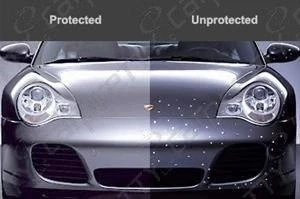
In the 21st century, it has been proposed to use rhinoceros leather in family cars to protect our original car paint. With the birth of this idea, the biggest difference from the previous application scenario is that in addition to the requirements of the protective function attributes, the family car as an appearance part, whether it has long-term aging resistance and no yellowing performance, also puts forward a key test.
With the continuous decline in the comprehensive cost of car clothing in recent years, car clothing has also entered the public eye.