1
Introduction to isocyanates
Isocyanates are important components required for the synthesis of polyurethanes, and they have one or more N=C=O functional groups on their molecules, which can be aliphatic, cyclic aliphatic, polycyclic or aromatic in nature.
The most common isocyanates in industrial settings are based on molecules with two N=C=O functional groups, commonly referred to as diisocyanates, including methylene diphenyl diisocyanate (MDI), toluene diisocyanate (TDI), hexamethylene diisocyanate (HDI), isophorone diisocyanate (IPDI), distilled diisocyanate (NDI), etc.
In general, we refer to isocyanates other than aromatic products as aliphatic diisocyanates (ADIs), including hexamethylene diisocyanate (HDI), isofulone diisocyanate (IPDI), dicyclohexylmethane-4,4'-diisocyanate (HMDI), methylcyclohexane diisocyanate (HTDI), benzenedimethylene diisocyanate (XDI), trimethyl hexamethylene diisocyanate (TMDI), Tetramethylisophenyl methylene diisocyanate (TMXDI). Among them, the output of HDI products accounts for about 2/3, and the output of HDI, IPDI and HMDI together accounts for more than 85% of the global aliphatic isocyanate production.
The polyurethane material prepared by ADI has excellent anti-aging, exposure and yellowing resistance, and is a key basic material to support the development of aerospace and military industry, high-end equipment, automobile and other industries, as well as a key raw material for the green upgrading of traditional industries such as coatings, adhesives, and artificial leather, and is known as the "pearl" in the crown of the polyurethane industry.
2
Analysis of the development status of the isocyanate industry
The MDI industry presents an oligopoly situation, with a total global MDI production capacity of about 10.4 million tons/year, and the top five producers are Wanhua Chemical (2.65 million tons), BASF (1.81 million tons), Covestro (1.77 million tons), Dow Chemical (1.36 million tons), and Huntsman (1.35 million tons), with a high industrial concentration and a CR5 of more than 88%. In addition, only one local producer, Wanhua Chemical, has achieved industrial production, and the rest of the producers are all foreign-owned.
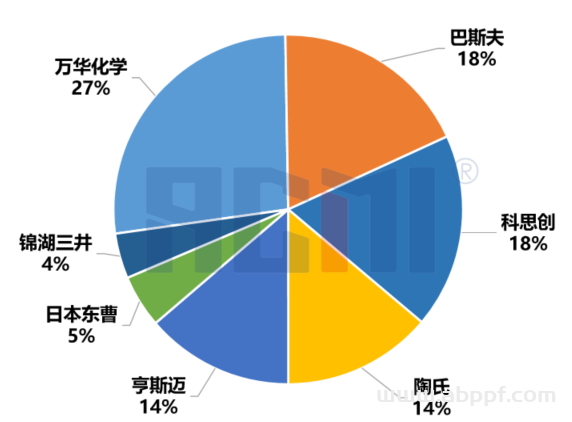
Figure 1 Comparison of the production capacity of major MDI manufacturers in the world
In the next few years, MDI's planned and under-construction capacity will be nearly 3 million tons/year. Among them, Wanhua Chemical's planned and under-construction production capacity has reached 1.4 million tons/year, accounting for nearly half, so Wanhua Chemical will be the main force in MDI's expansion in the next few years; Covestro and BASF have 500,000 mt/year and 440,000 mt/year of planned and under-construction capacity respectively, and the rest total is about 700,000 mt/year.
From the perspective of supply, China's MDI production capacity has grown steadily in recent years, and the growth rate has gradually slowed down, and the supply of MDI will continue to grow in the future with the release of production capacity. From the perspective of demand, the largest proportion of downstream consumption of polymerized MDI is refrigerator freezer, and the growth trend of export demand for refrigerator freezer in the past two years is improving, which will drive the growth of aggregate MDI market demand.
(1) Overview of existing production capacity
The TDI industry is similar to MDI, with an oligopoly pattern, with major producers including BASF, Covestro, Wanhua Chemical, Yantai Juli, etc.
At present, TDI has a total global production capacity of about 3.7 million tons/year, and CR3 is as high as 67%. Among them, BASF is the largest producer, with a total production capacity of about 920,000 tons/year, including 220,000 tons/year of BASF in Shanghai, 160,000 tons/year of BASF in South Korea, 380,000 tons/year of BASF in Germany and 160,000 tons/year of BASF in the United States. The second largest producer is Covestro, with a total production capacity of about 910,000 mt/year, including 310,000 mt/year from Covestro in Shanghai, 300,000 mt/year from Covestro in Germany and 300,000 mt/year from Covestro in the United States. Wanhua Chemical is the third largest producer, with a domestic production capacity of 400,000 tons/year, a Hungarian base with a production capacity of 250,000 tons/year, and a total production capacity of 650,000 tons/year, and the rest of the producers have a smaller production capacity, mostly around 100,000 tons/year, including South Korea's Hanwha, Japan's MCNS, Cangzhou Dahua, etc.
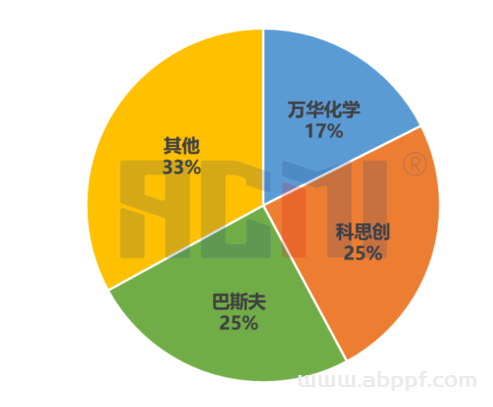
Figure 2 Comparison of the production capacity of major TDI producers in the world
The largest domestic manufacturer is Wanhua Chemical, which has TDI production bases in Yantai and Fujian, with a production capacity of 300,000 tons/year and 100,000 tons/year respectively, with a total production capacity of 400,000 tons/year; Covestro is the second largest producer, with a 310,000 mt/year production facility in Shanghai. Yantai Juli and BASF are the third and fourth largest producers respectively, with production capacity of 230,000 tons/year and 220,000 tons/year respectively; The production capacity of Cangzhou Dahua, Gansu Yinguang and Lianshi Chemical is 150,000 tons/year, 100,000 tons/year and 50,000 tons/year respectively.
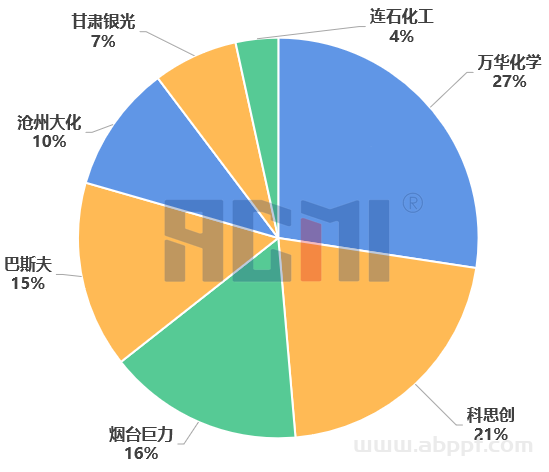
Figure 3 Comparison of production capacity of major TDI producers in China
(2) New domestic production capacity
In the next few years, the new domestic TDI production capacity will mainly come from Wanhua Chemical and Cangzhou Dahua.
In June 2021, Wanhua Chemical announced the environmental impact report of Wanhua Chemical (Fujian) Co., Ltd.'s expansion of 250,000 tons/year TDI project (draft for comments). According to the EIA, Wanhua Chemical plans to invest about 1.9 billion yuan to expand the existing 100,000 tons/year TDI project to a 250,000 tons/year project in the Fujian base, which is expected to be completed in 2 years, and the project has not yet started.
Cangzhou Dahua Project plans to build a 400,000-ton TDI expansion and transformation project. According to the relevant environmental assessment, Cangzhou Dahua will expand the original 50,000 tons/year TDI unit and 70,000 tons/year TDI unit to 160,000 tons/year, reaching 160,000 tons/year TDI production capacity; Expansion of a 225,000 tons/year TDI plant, bringing the total TDI production capacity to 385,000 tons/year. The project will be constructed in two phases, the first phase will build a 225,000 tons/year TDI unit; In the second phase, the original 50,000 tons/year TDI unit and 70,000 tons/year TDI unit will be expanded and transformed to reach 160,000 tons/year TDI production capacity.
(1) Industry overview
ADI's production process is long, and the production process involves complex organic synthesis, phosgene reaction and other processes, which is not only technically difficult, but also has a high barrier to entry because it needs to effectively control the required chlorine and toxic phosgene. Up to now, only a handful of companies in the world have been able to produce ADI on a large scale, such as Covestro, Evonik, Conrui, BASF, Asahi Kasei and Wanhua Chemical.
At present, the total global ADI production capacity is about 540,000 tons, of which Covestro has the largest production capacity, more than 200,000 tons/year, followed by Wanhua Chemical (130,000 tons/year), and in the future, with the commissioning of Wanhua Ningbo's 50,000 tons/year HDI plant, the gap between it and Covestro will be narrowed.
(2) Subdivisions
In terms of products, HDI has long been dominated by foreign-funded enterprises, Covestro and Kangrui are the global leaders, with a total production capacity of more than 60%, and Wanhua is the only domestic supplier, with a current production capacity second only to Covestro.
IPDI manufacturers mainly include Wanhua, Covestro, Evonik, Kangrui and BASF, and Wanhua Chemical's production capacity is in the third place, but the gap with other enterprises is small.
In terms of HMDI, at present, only Wanhua Chemical, Covestro and Evonik have production capacity in the world, and Wanhua is the first and only independent supplier of HMDI in China, with a production capacity of 20,000 tons/year with Covestro and Evonik.
Globally, Covestro is the inventor of aliphatic isocyanate derivatives and is the world's leading producer of aliphatic and aromatic isocyanate derivatives and each aliphatic monomer (HDI, IPDI, HMDI, PDI, etc.).
Domestically, Wanhua Chemical is the only local manufacturer of ADI.
In 2012, Ningbo Wanhua's 15,000-ton HDI production unit was put into operation, marking Wanhua's large-scale industrial production of ADI.
In 2016, Wanhua completed the IPDI and HMDI industrialization plant and put it into production, becoming one of the few enterprises in the world with the industrial production capacity of HDI, IPDI and HMDI.
Wanhua Chemical is the only enterprise in the world that has mastered the core technologies of the whole industry chain MDA-H12MDA-H12MDI, the second in the world to master the whole industry chain IP-IPN-IPDA-IPDI, and the only company in China that has mastered the core technologies such as HDI and derivatives.
At present, Wanhua Chemical's total ADI production capacity reaches 130,000 tons/year, accounting for 24% of the world's total, and it is expected that another 50,000 tons/year HDI will be put into operation in 2023, when its total ADI production capacity will reach 180,000 tons/year. While continuously expanding the production capacity of ADI products, Wanhua is also building a special amine-ADI-PUD industry chain to promote the integrated development of the ADI industry.
3
brief summary
Due to high technical requirements and large capital investment, domestic local isocyanate manufacturers are extremely rare, and most of the products (except TDI) are only Wanhua Chemical has large-scale production capacity, and the rest are foreign-owned.
With the completion and operation of domestic isocyanate-related projects, China has become an important aliphatic isocyanate manufacturing place in the world, and the domestic isocyanate industry chain has been more perfect, but it is also facing the problem of surplus low-end products and insufficient supply of high-end products, and due to high technical barriers, the probability of new entrants in the isocyanate industry in the future is small, and Wanhua Chemical will become the main force in the development of the isocyanate industry.