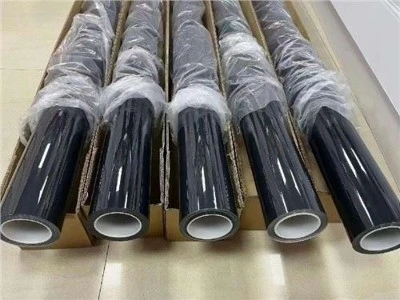
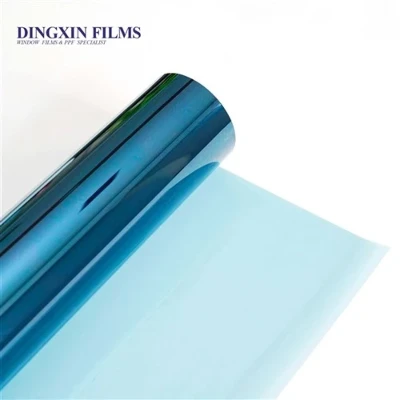
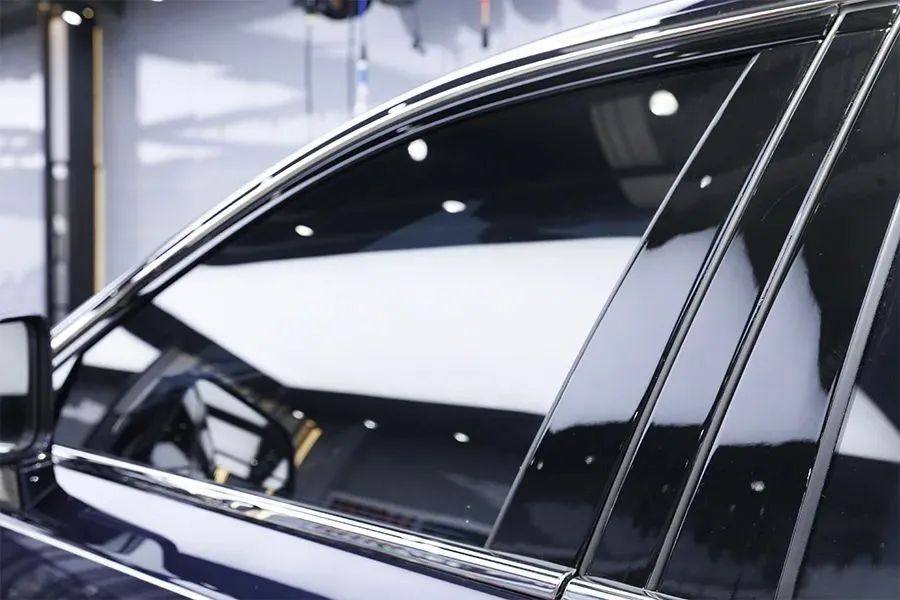
Car thermal insulation film is becoming more and more popular in daily life. For car owners, the thermal insulation film not only enhances privacy, but also blocks direct sunlight, plays a heat insulation effect, and is full of practicality. But do you know the history of automobile insulation film? Do you know that the origin of automobile insulation film is related to Edison! Today, the editor will introduce to you the origin, development and process history of automobile insulation film!
Origin of automobile insulation film
After Edison invented the phonograph in 1888, he turned his attention to developing motion pictures. During his research, he found that the darker the film, the better it could block and absorb the heat emitted by the electric light. As a result, this accidental discovery was gradually adopted by later generations and became the basis and origin of the birth of thermal insulation film.
Development of automotive insulation film
With the continuous progress of history, automobile insulation film has gone through a total of 5 periods ( or "five generations " );
First generation: sun paper ( tea paper )
Positioning: Thermal insulation film enters the market;
Process: The coating composite process is used;
Features: Used to block strong sunlight and does not have heat insulation function;
Introduction: The early solar paper, commonly known as tea paper, was mainly used to block strong sunlight. This type of film has basically no thermal insulation effect and is only used for shading. Like sunglasses, they only change the visual light perception, and the surface of the sunglasses is also very hot. Therefore, such products have poor thermal insulation, are easy to fade, and have extremely poor clarity. As people's requirements for heat insulation increase, tea paper slowly fades out of the market.
Second generation: heat-absorbing membrane (dyed membrane)
Positioning: Thermal insulation film comes into being;;
Process: Dyeing process is used;
Features: Absorbs infrared rays to achieve heat insulation effect, sacrificing clarity ( poor clarity ), easy to fade ( color fades, heat insulation function attenuates );
Introduction: The heat-absorbing film is also called dyeing film. Most of the ones currently on the market are deep dyeing processes. The heat-absorbing agent is added with the deep dyeing method to absorb the infrared rays in the sun to achieve the effect of heat insulation. Because it also absorbs visible light, the visible light transmittance is insufficient. In addition, due to the limitations of the dyeing process itself, the clarity is poor. In addition to poor clarity, another major weakness of this type of film is that the thermal insulation function decays quickly and is prone to fading. After a period of time ( perhaps half a year or a year ), the film will fade, no longer insulate, and will bubble, seriously affecting the visual appearance. This type of film is particularly suitable for instant heat insulation tests ( 4S stores will use this feature to fool customers ). Color can be directly observed with the naked eye.
On December 6, 1966, the American 3M Company obtained the world's first patent for solar insulation film.
Third generation: metal film
Positioning: Thermal insulation film is booming;
Process: Vacuum thermal evaporation process;
Features: Add a metal layer to the film and use reflection to achieve heat insulation effect. The clarity is not high and it is easy to reflect light.
Introduction: This type of membrane was produced in the early 1990s. The vacuum thermal evaporation process is to evaporate the aluminum layer on the substrate and use reflection to achieve the heat insulation effect. It marks that the thermal insulation film has officially entered the era of metal films. It has longer-lasting thermal insulation, but its weakness is that the clarity is not high, which affects the comfort of the field of vision. Another outstanding feature of it is its high reflection. Aluminized film is one of the most obvious representatives. They and dyed films hold the largest share in the market.
Major brands in the market: 3M, Ray-Ban, Johnson & Johnson, Youma Film, etc.
Fourth generation: modern metal film (improved)
Positioning: The insulation film technology is mature;
Process: Vacuum magnetron sputtering technology;
Features: Multiple metal layers are sputtered on the film, using reflection to achieve heat insulation effect. It is high-definition and non-reflective, but will interfere with the signal.
The fourth generation of vacuum magnetron sputtering technology officially entered the market in the late 1990s and has experienced a variety of technological innovations. The magnetron sputtering process uses advanced aerospace alloy materials such as nickel, silver, titanium, gold, and ceramic materials. The most advanced multi-cavity high-speed rotating equipment uses the principles of electric and magnetic fields to uniformly sputter metal particles on high-tension PET substrates at high speed and force. In addition to having a good metallic texture and stable heat insulation properties, the products produced by the magnetron sputtering process also have clarity, low reflection and long-lasting color that cannot be achieved by other processes. A truly high-quality film can achieve high definition, high heat insulation, low reflection, and no dyeing at the same time. It is a mainstream technology product on the market.
However, the shortcomings of the metal film are also obvious. Due to the physical characteristics of the metal itself, the metal film is easy to oxidize and will block signals from in-car wireless communication systems such as GPS. Currently, car configurations are generally upgraded, including DVD navigation systems, electronic dogs, and more. The disadvantages of mobile phones, highway wireless toll collection systems, and metal films on cars are obvious.
Major brands in the market: Saint-Gobain, VAG, Lonfilm and other brands.
Fifth generation: ceramic film (IR film)
Positioning: Advanced insulation film technology;
Process: Spectral selection technology;
Features: Multiple layers of nano-ceramic layers are sputtered on the film, using reflection to achieve heat insulation effect. It is high-definition and non-reflective, but will interfere with the signal.
The fifth generation of automotive insulation film is "ceramic film", which is different from traditional films made of metal or dyeing processes. The original ceramic film is internationally known as "IR film" or "endothermic film" "Film, through a coating layer containing ITOATO ( metal oxide powder ), strongly absorbs infrared and ultraviolet rays. Compared with metal films, it solves the problem of oxidation and metal layer shielding signals, and its service life is more than twice that of metal films. The improved version of the nano-ceramic film uses spectrum selection technology, reflection plus spectrum selection transmission, and truly achieves the nine standards of a perfect window film: no oxidation, no fading, no blocking of GPS, high heat insulation, high light transmittance, low reflection, Durable color, long life, and high explosion-proof performance. Moreover, the construction requirements are relatively high. If you are not careful, the membrane will be burned and ceramic cracks or bubbles will appear.
Representative brands in the market include: Saint-Gobain ceramic film, Lonco ceramic film, Amber optical nano-ceramic insulation film, and Chiasero nano-ceramic insulation film.
To sum up, the origin of automotive insulation film originated from a small discovery; and then it went through five generations of continuous upgrading and improvement of different processes and technologies, resulting in the products we see today with mature technology and excellent performance.


 Language