Superhydrophobic material is a biomimetic material prepared by researchers after studying the surface microstructure of lotus leaves, rose petals and other animals and plants, and the hydrophilic and hydrophobic properties of the materials are affected by the wettability of the materials.
When the contact angle (CA) between the surface of the material and the water is greater than 150° and the rolling angle (SA) is less than 10°, this kind of material is called superhydrophobic material.
According to the influence of solid surface microstructure and surface free energy on solid surface wettability, it can be seen that the preparation of superhydrophobic materials can be achieved by constructing rough structures on the surface of materials and modifying the surface of materials with low surface energy substances.
Since a single low surface energy substance can only make the contact angle of water droplets on the surface of the material reach 120°, but cannot achieve the effect of superhydrophobicity, the introduction of surface roughness is very necessary.
Generally, superhydrophobic materials are obtained by introducing roughness on the surface of the material and then adding low surface energy substances for modification. The preparation methods of superhydrophobic materials include template method, etching method, spraying method, electrospinning method, sol-gel method, etc., and the advantages and disadvantages of various preparation methods are shown in Table 1.

In the case of physical wear and chemical corrosion, ordinary superhydrophobic materials can easily lose their superhydrophobic properties, thus affecting their normal use. In order to improve the durability and stability of superhydrophobic materials, some researchers have introduced self-healing into the structure of superhydrophobic materials inspired by self-healing materials, so as to prepare self-healing superhydrophobic materials that can be reused.
Self-healing superhydrophobic materials can be divided into two types according to the repair mechanism, one is the external-aided self-healing superhydrophobic material, and the other is the intrinsic self-healing superhydrophobic material.
For more industry information, welcome to join the Aibang Automotive Film Industry Exchange Group
External-aided self-healing superhydrophobic coating material
Externally-aided self-healing superhydrophobic coating materials can repair the damage on the surface of superhydrophobic coating materials by storing the repair agent (low surface energy substance) inside the superhydrophobic material by means of microcapsules, liquid fibers, self-similar structures, etc.
When the surface of the material is damaged, it can be stimulated by changing the conditions such as light, temperature, pH, etc., so that the repair agent inside the material is released and migrates to the damaged part of the material, so that the damaged surface can heal and the material can recover superhydrophobic.
The advantages and disadvantages of these three external-aided self-healing methods are compared in terms of environmental protection, repair speed and service life, as shown in Figure 1.
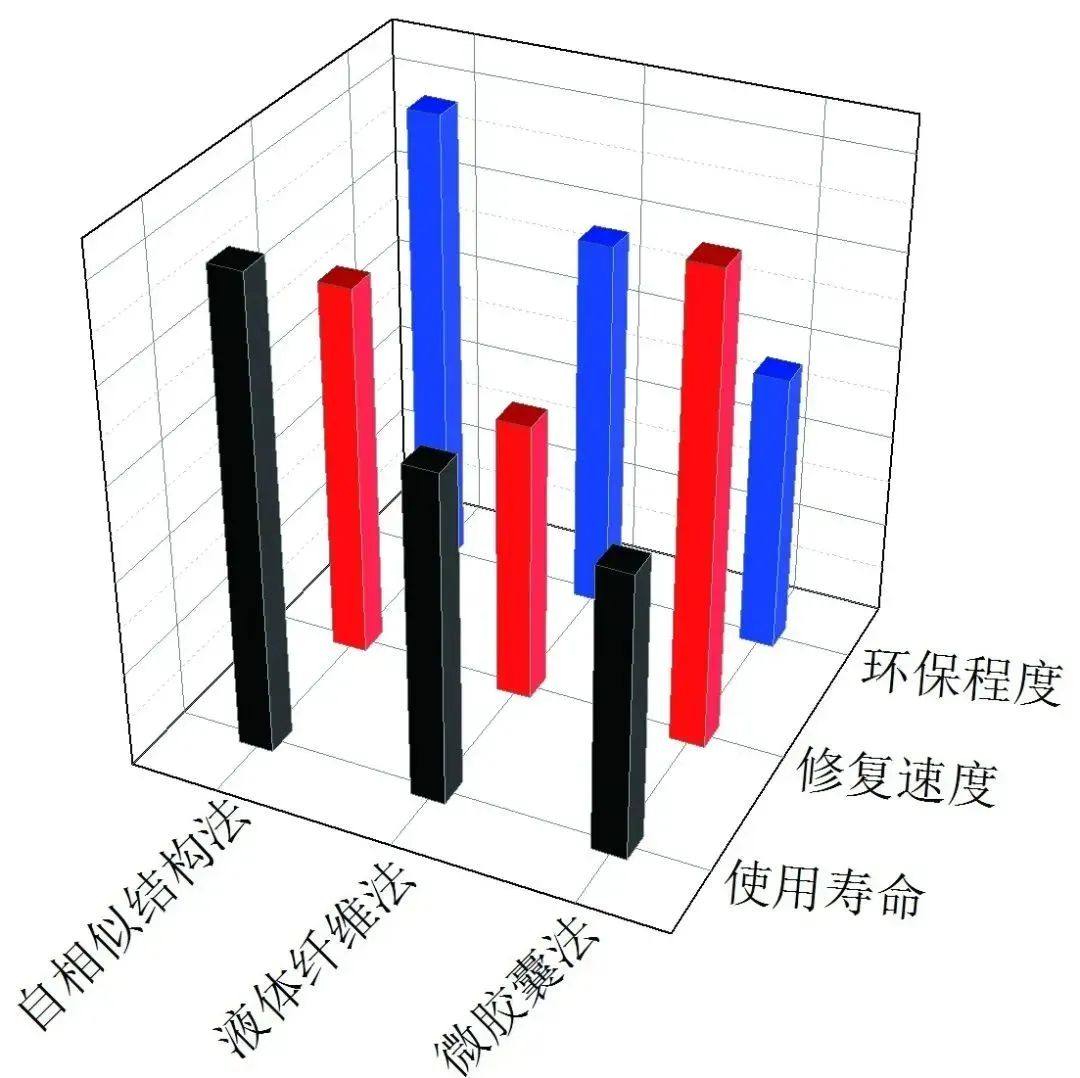
It can be seen that the microencapsulation method has the fastest repair speed, but the environmental protection and durability of the self-similar structure method are the best, which is mainly because the microcapsule method and the liquid fiber method will be released after several "destruction-repair" cycles, and the material will lose its self-healing ability.
The superhydrophobic self-healing materials prepared by the self-similar structure method have the same hydrophobic composition and structure on the surface and inside, and the repair process can be realized by rubbing or decomposing to expose the rough structure after the surface is damaged, so as to prolong the service life.
When the surface of the superhydrophobic material is damaged, the repair agent inside the capsule can be released and migrate to the damaged surface through specific stimulation, so that the surface of the material can be repaired. The microencapsulation method is simple to operate and widely used.
Liquid fiber repair is to bury the liquid fiber in the composite material, encapsulate the repair agent in the liquid fiber, when the material is damaged, the liquid fiber breaks, and the repair agent flowing out of the fiber can bond the crack or react with the catalyst in the material to repair the crack.
The superhydrophobic self-healing material prepared by the liquid fiber method will gradually decrease with the continuous use of the repair agent, and the material will lose its self-healing ability when the repair agent is used up.
Intrinsic self-healing superhydrophobic coating material
Due to the limited storage capacity of the externally-aided self-healing material repair agent, the material will lose its self-healing performance and have a limited service life when the repair agent is consumed.
In order to prolong the service life of self-healing superhydrophobic materials and repair materials with scratches, cracks and fractures, researchers have gradually explored an intrinsic self-healing material that can realize the self-healing process without adding any repair agent and only by its own chemical structure characteristics under specific conditions.
This method introduces dynamic chemical bonds into the internal structure of the material, and when the material is broken, under the stimulation of certain conditions, the broken chemical bonds will return to the initial state due to dynamic equilibrium, so that the structure and state of the material can be restored, and the durability and reusability of the material are improved.
Intrinsic self-healing materials can be divided into reversible non-covalent bonds and reversible covalent bonds.
Reversible non-covalent bonds include hydrogen bonds, metal coordination bonds, and ionic bonds, and reversible covalent bonds include disulfide bonds, acylhydrazone bonds, boron-oxygen bonds, imine bonds, Diels-Alder reactions, and Se-N.
Reversible non-covalent bonds include hydrogen bonds, metal-coordination bonds, and ionic bonds, and their characteristics are shown in Table 2.
When the internal structure of the material is damaged due to chemical corrosion or physical wear, the material can be reconstituted by hydrogen bonds or metal coordination bonds to repair the damaged parts, so that the superhydrophobicity of the material can be restored.

However, the stability of covalent bonds is higher than that of non-covalent bonds, and the construction of covalent cross-linking networks with reversible covalent bonds can not only make the materials have self-healing properties, but also increase the stability of the materials.

epilogue
Self-healing superhydrophobic coating materials have become a hot topic of current research due to their excellent functionality and economy. However, the research on self-healing superhydrophobic coating materials is still in its early stages, and there are still many problems to be solved:
(1) The functional modification group is relatively simple, and superhydrophobic functionalization is mainly modified with fluorine-containing substances, which have potential hazards to the environment and human health;
(2) At present, most of the methods for preparing self-healing superhydrophobic coating materials are to simply superimpose the self-healing properties and superhydrophobic properties, and the functions of the two are not organically combined, and their greater synergistic effects and functional properties need to be explored.
(3) The selection of substrate is very important for superhydrophobic coatings (especially thin films), the structure and properties of the substrate will affect the migration of low surface energy substances, and its microstructure and roughness have a great impact on the performance of superhydrophobic coating materials, but there are few such studies at present;
(4) The application of self-healing superhydrophobic coating materials is limited, and its application field needs to be further developed.
Therefore, for the future research direction of self-healing superhydrophobic coating materials, we believe that the following points can be carried out:
(1) In-depth study of the self-healing process and superhydrophobic mechanism of self-healing superhydrophobic coating materials, so as to provide a theoretical basis for the functionalization and performance improvement of materials;
(2) to develop other preparation methods for self-healing superhydrophobic coating materials, and to find the functional units and preparation conditions of other external-aided and intrinsic self-healing superhydrophobic coating materials preparation methods in addition to the existing preparation methods;
(3) To explore the universal laws and theories of the influence of substrate micro-nano structure, roughness, hydrophilicity and chemical stability on superhydrophobic coating materials;