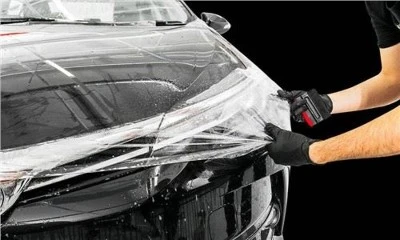
Paint protection film has a coating and a glue layer. These two layers of structure are mostly obtained through the coating process. Some factories use TPU base film to be directly coated on both sides, and some use coating to directly coat the TPU film and glue. The PET film is then transferred to the TPU film.
If PET glue is applied and then transferred, then due to the low surface energy of the PET film, the PET film usually needs to be corona treated during the coating process to improve the surface adhesion of the PET film.
1. Corona principle
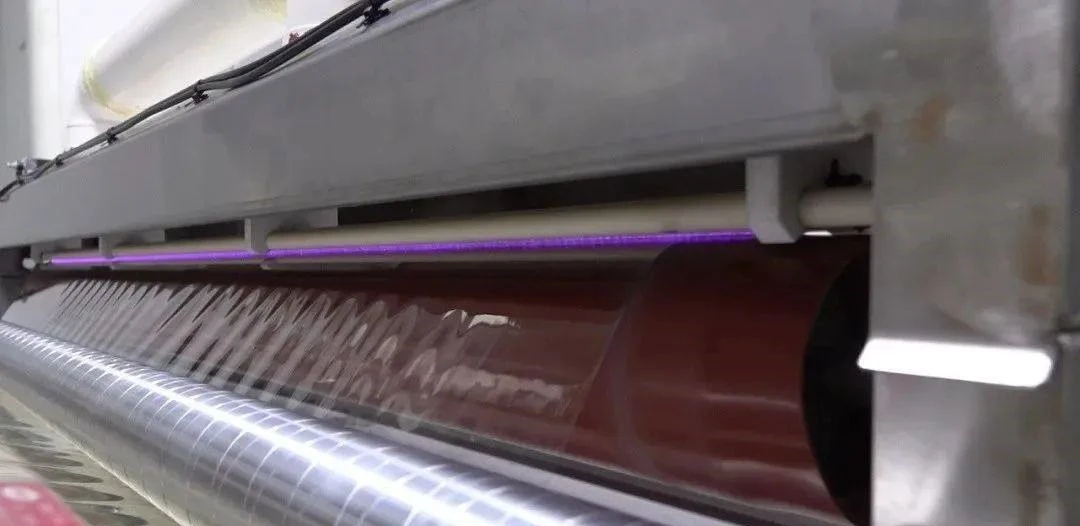
High-frequency and high-voltage electricity is applied to the treatment device to cause corona discharge, producing small and dense purple-blue sparks. Various plasmas generated after air ionization are accelerated under the action of strong electric field, thereby impacting the plastic products in the processing device.
The energy of these plasma particles is generally several to tens of electron volts, which is close to the chemical bond energy of plastic molecules. Therefore, it can induce the breakage of chemical bonds of plastic surface molecules and cause degradation, increasing surface roughness.
During corona discharge, a large amount of ozone is also produced. Ozone is a strong oxidant that oxidizes molecules on the surface of plastics to produce carbonyl compounds, peroxide compounds, etc. In addition, corona treatment can also remove oil, water vapor and dirt. After the above-mentioned physical and chemical modifications, the wettability and adhesion of the plastic surface can be significantly improved.
2. Three different corona methods
On the film production line
It is commonly known as hot film treatment, which is the most common form of treatment. Since the polymer molecules are processed before they have completed crystallization, the treatment effect is strong, but it is generally only suitable for film treatment that will be reprocessed immediately (such as printing, coating or lamination). The processing device is arranged behind the film cooling and shaping section and before the winding device.
2. Performed on the film reprocessing line
Commonly known as cold film treatment, the quality of this form of treatment is also related to the experience of the film. If the film is stored for a long time after production, a large amount of precipitated additives will adhere to the surface of the film, and the processing quality will deteriorate. When choosing this method, attention should also be paid to whether electric sparks may cause ignition of the solvent used. The processing device is installed before the printing (or coating, laminating) device.
3. A combination of the above two forms
That is, it is processed first on the film production line, and then processed a second time on the film reprocessing line. It is suitable for films with poor quality during the first treatment, or films that have been stored for a long time after the first treatment and the treatment effect has faded a lot.
3. Advantages of thin film corona:
1. A wide range of processing materials can be used for polyethylene, polypropylene, polyvinyl chloride, polyamide, polyester, polycarbonate, fluoroplastics, and various corresponding copolymers;
2. The processing time is short and the speed is fast, and can be processed on the production line;
3. Simple operation and easy control;
4. Corona treatment only involves a very shallow area of the plastic surface, generally only on the order of nanometers, and basically does not affect the mechanical properties of the product;
5. No waste liquid discharge, basically no environmental pollution.
4. Factors affecting corona effect
1. Temperature: As the temperature increases, the degree of processing increases.
In actual production, if the power of the corona treatment machine is small and the treatment degree is not enough, red radiation, etc. (referred to as cold film treatment) can be set up in front of the treatment device to improve the treatment degree.
2. Humidity: If the air humidity is high, the treatment effect is often not ideal because corona discharge is performed in the air.
3. Time: The degree of corona treatment will fade with the extension of storage time.
4. Storage environment: The speed of fading is related to various factors such as the temperature of the storage environment and the thickness of the material. The higher the temperature of the storage environment, the faster and more thoroughly it will subside (generally, the best validity period after IXPE corona treatment is within half a month, and it will slowly subside after half a month).
5. Resin physical properties: Films made from raw materials containing additives fade faster than those without additives. This is because these low molecular weight substances are easily precipitated and cover the surface of the film, making the adhesion worse.
6. Film thickness: Thick films fade faster than thin films.
5. Causes and solutions for uneven film corona treatment
1. The surface tension in the same roll of film is uneven. It is low in some places and high in other places. Sometimes it is found that one section is high and the other is low, or even the surface tension of one section seems to have not been processed. The bonding fastness and printing fastness are very unsatisfactory. This may be caused by unstable voltage or a temporary power outage where no spark occurs and the corona treatment is stopped. Because the spark generator is a high-voltage discharge device, if the voltage used is unstable, sometimes high and sometimes low, the intensity of the spark will also fluctuate, sometimes high and sometimes low, or even intermittently, and the surface tension will be uneven, with high There are low.
2. Another situation is that some parts of the longitudinal direction have lower tension, or half is high and half is low. This may be due to the fact that the spark generator is not parallel to the film being processed, or that part of the generator is contaminated by dust, resulting in concentrated discharge, which is particularly strong in some places and weak in other places, resulting in strip-like unevenness when viewed longitudinally. . Therefore, before starting the machine, it is necessary to calibrate the parallelism and distance between the generator and the membrane. Do not have one side close and the other far. In addition, it is necessary to remove the dust adhered to the generator while allowing it to discharge evenly.
When testing the surface tension of the film, the left, middle, and right positions of the film's transverse width should be tested instead of just testing one part, so as to reduce the probability of missed detection.