Light-curing technology is a high-efficiency, environmentally friendly, energy-saving, high-quality material surface technology, known as a new technology for green industry in the 21st century. With the development of science and technology, the application of light-curing technology has developed from the earliest printed plates and photoresists to light-curing coatings, inks and adhesives, and the application field has been expanding, forming a new industry.
Light-curing products are most commonly divided into UV coatings, UV inks and UV adhesives, their biggest feature is that the curing rate is fast, generally between a few seconds and tens of seconds, and the fastest can be cured in 0.05~0.1s, which is the fastest drying and curing in various coatings, inks and adhesives.
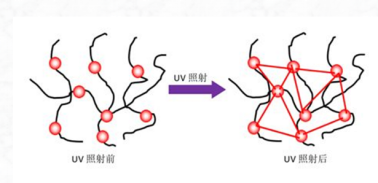
UV curing is ultraviolet curing, UV is the English abbreviation of ultraviolet light, curing refers to the process of transforming a substance from low molecule to high molecule. UV curing generally refers to the curing conditions or requirements of coatings (paints), inks, adhesives (glues) or other potting sealants that need to be cured with ultraviolet light, which is different from heating curing, adhesive (curing agent) curing, natural curing, etc. [1].
The basic components of light-curing products include oligomers, reactive diluents, photoinitiators, additives, and more. Oligomers are the main body of light-curing products, and their properties basically determine the main properties of cured materials, so the selection and design of oligomers is undoubtedly an important part of the formulation of light-curing products.
What these oligomers have in common is resins with "unsaturated"  double bonds, ranked by the rate of radical polymerization: acryloyloxy> methacryloyloxy> vinyl> allylene.
Therefore, the oligomers used in free radical light curing are mainly various acrylic resins, such as epoxy acrylates, polyurethane acrylates, polyester acrylates, polyether acrylates, acrylates, acrylic resins or vinyl resins, etc., and the most practical applications are epoxy acrylic resins, polyurethane acrylic resins and polyester acrylic resins. The three resins are briefly described below.
Epoxy acrylic number is currently the most widely used and largest amount of light-curing oligomers, which are prepared by esterification of epoxy resin and (metha)acrylate. Epoxy acrylate can be divided into bisphenol A epoxy acrylate, phenolic epoxy acrylate, modified epoxy acrylate and epoxy acrylate according to the structure type, with bisphenol A epoxy acrylate being the most widely used.
Bisphenol A epoxy acrylate is one of the fastest light-curing rates in oligomers, and the curing film has high hardness, high gloss, excellent chemical resistance, good heat resistance and electrical properties, coupled with the simple formula of bisphenol A oxyacrylate raw materials, and the price is cheap, so it is often used in the main resin of light-curing paper, wood, plastic, and metal coatings, and is also used as the main resin of light-curing ink and light-curing adhesive.
Polyurethane acrylates (PUAs) are another important light-curing oligomer. It is synthesized by a two-step reaction with polyisocyanates, long-chain glycols and hydroxyl acrylates. Due to the selectable multi-structure of polyisocyanates and long-chain diols, oligomers with set properties are synthesized through molecular design, so they are currently the most widely used oligomers in light-curing coatings, inks and adhesives.
Polyester acrylate (PEA) is also a common oligomer, which is made from low molecular weight polyester glycol by acrylic esterification. The low price and low viscosity of polyester acrylates are the biggest features, due to the low viscosity, polyester acrylates can be used both as oligomers and as reactive diluents. In addition, polyester acrylates mostly have low odor, low irritation, good flexibility and pigment wetting, suitable for pigments and inks. In order to increase the high curing rate, polyester acrylates with multi-functionality can be prepared; The use of amine-modified polyester acrylates not only reduces the effects of oxygen inhibition and increases the curing rate, but also improves adhesion, gloss and abrasion resistance.
Reactive diluents usually contain reactive groups that dissolve and dilute oligomers, and play an important role in the light-curing process and coating properties. According to the number of reactive groups contained, monofunctional reactive diluents commonly include isodecyl acrylate, lauryl acrylate, hydroxyethyl methacrylate, glycidyl methacrylate, etc.; Difunctional reactive diluents include polyethylene glycol diacrylate series, dipropylene glycol diacrylate, neopentylene glycol diacrylate, etc.; Multifunctional reactive diluents such as trimethylolpropane, triacrylate, etc.[2].
The initiator has an important impact on the curing rate of light-curing products, and the addition of photoinitiator in light-curing products is generally 3%~5%. In addition, pigments and filler additives have a significant impact on the final performance of light-curable products.