At present, most of the invisible car clothing has a self-healing function, when the car body is scratched or slightly impacted, on the basis of not damaging the base film of the car clothing, with hot water or hot air treatment, small scratches will gradually disappear, and the surface of the car clothing will be restored as before.
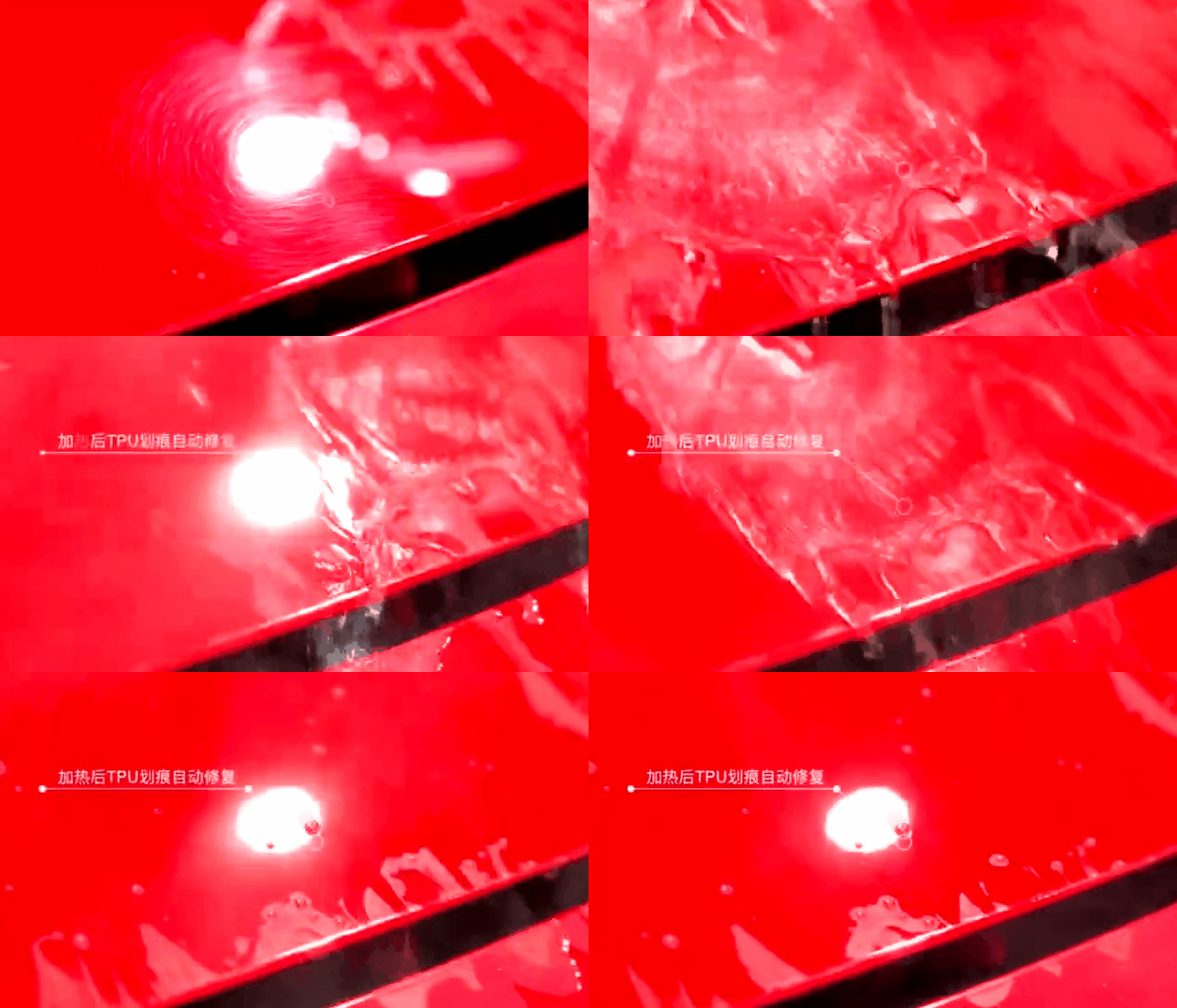
This self-healing effect is mainly determined by the polymer structure of the self-healing resin in the top coating.
Thermal repair: hot water, hot air or sunlight above 60°C is required to act on the scratch;
Repair in seconds: not affected by external influences, but this type of resin is soft and not dense enough;
At present, most of the market has turned to thermal repair, and there are a small number of second-to-second repair products abroad. The common resin component in the car coating is polyurethane resin composed of polyhydroxyacrylate, flanine isocyanate-resistant and other monomers, which is mainly applied based on the hydrogen bond self-healing mechanism in the intrinsic type.
The three elements of self-healing are indispensable:
The driving force of the repair reaction: heat, light, electricity, magnetism, etc.;
Segment kinematics: the flexibility of the segment and the glass transition temperature (Tg) of the polymer, that is, under the condition of driving force, the polymer can move, and there is a chance of collision;
Reversible bonding: non-covalent bonding (van der Waals forces, hydrogen bonding, metal coordination, host-guest ligands, charge interaction), covalent bonding (Diels Alder reaction, disulfide bond, hydrazone, alkoxyamine, borate bond).
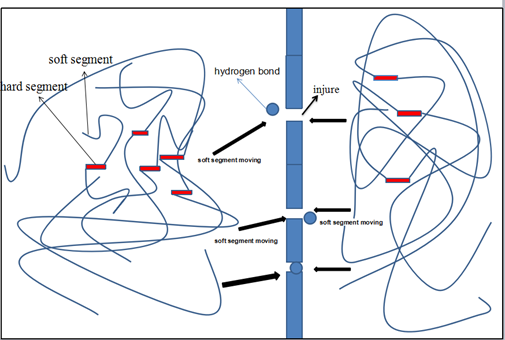
Mechanistic model of intrinsic self-healing
1. Self-healing properties are not achieved by reacting with active functional groups at the damaged location, but by hydrogen bonding;
2. Hydrogen bonding produces a strong interaction force to achieve macroscopic side damage healing;
3. Hydrogen bonding is derived from the formation of a strong hydroxyl attraction at the air interface by a large number of ether groups inside the polyurethane resin.
4. In addition to the hydroxyl attraction formed by the ether group, sufficient molecular segment movement is also required;
5. Polyurethane's unique soft and hard block structure, the long-range movement of the soft segment in the room temperature environment ensures the migration of polymer molecular segments;
6. The migration of molecular segments ensures that after the contact of the damaged position, the originally separated polymer is re-"wound" under the migration of the soft segment;
7. "Winding" ensures that hydrogen bonding is introduced into the polymer system, resulting in macroscopic self-healing;
8. There is no long-range movement in the hard segments, which restricts the migration of the soft segments.