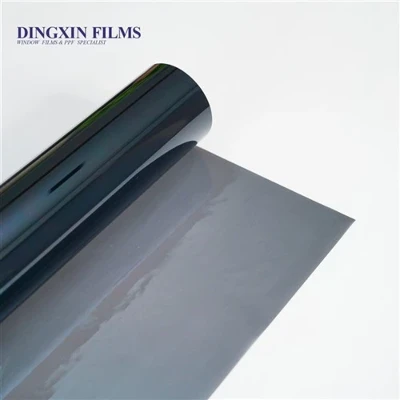
For TPU paint protection film, in addition to strong protection performance, adding brightness to the car is also one of the most favored features of car owners. The same TPU invisible car coat, why do some of them have an obvious brightening effect, while others look even darker? When choosing an invisible car coat, is gloss and haze a concept? What is the relationship between the two? How to choose an index?
01 Glossiness & Haze concept understanding
01
Glossiness
Glossiness is a physical quantity that evaluates the ability of a material's surface to reflect light under a set of geometrically specified conditions. Therefore, it expresses the reflective nature of having a choice of direction. According to the size of gloss, coatings can be divided into glossy, matte, matte, etc.
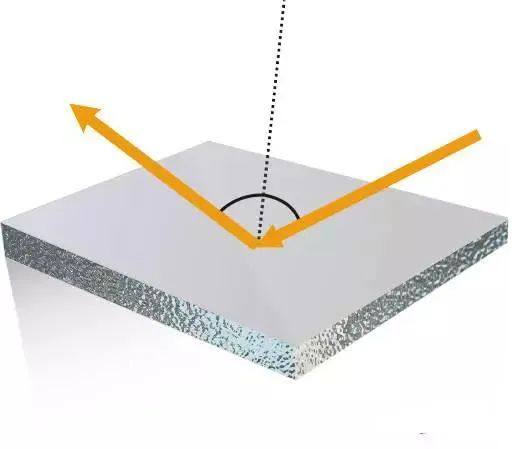
Glossiness can be understood as the subtle roughness of the surface of an object. That is, the smoother and more reflective the surface, the brighter the human eye feels, and the higher the gloss.
02
Haze
Haze is the percentage of the total transmitted light intensity that deviates from the angle of incident light by more than 2.5°, and we can understand the concept of haze as the ability to scatter light. As shown in the diagram, the light is scattered.
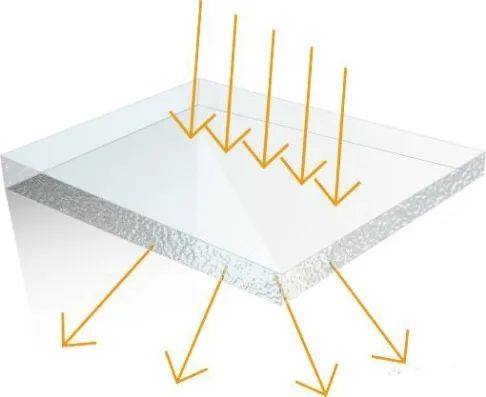
Haze is an important parameter for the optical transparency of the car coating film. The greater the haze, the stronger the ability to scatter light, which means that the gloss and transparency of the film, especially the imaging, are reduced, and the human eye is more unable to see.
In general, gloss and haze don't really matter. Haze represents the ability of the coating film to scatter light. Glossiness is the ability of the surface of the car coating film to reflect light. The amount of the test is completely different.
02 Glossiness & Haze Index
From the perspective of brightening the paint, both gloss and haze have an impact, and both need to reach a certain level to achieve the best results. If the gloss is high, but the haze is also high, there is a brightening effect, but the paint color will look distorted; If the haze is low, but the gloss is also low, then the brightening effect is not noticeable.
So, how are gloss and haze indices measured? Is there a standard?
Through visual inspection, it is easy to deviate, and we can use the gloss meter to accurately identify the difference in the gloss of different car coating films, or the difference in the gloss of automobile paint before and after the film; Similarly, a haze meter can also be used to detect the haze of the car coating film.
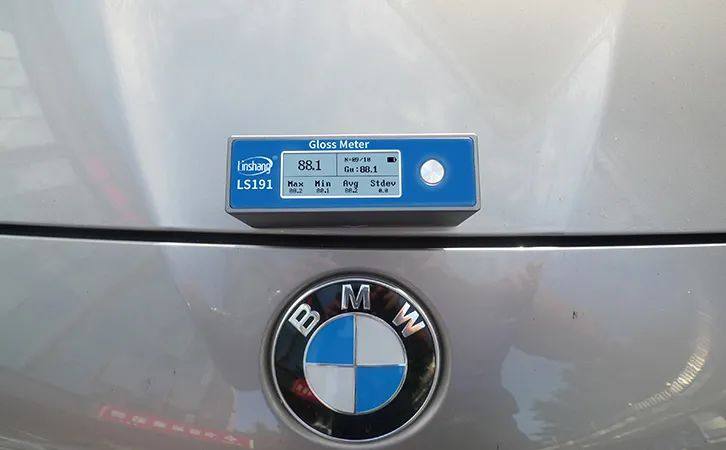
According to the standard proposed in the "Automobile Paint Protection Film", the glossy car coating film is divided into grade A and grade B according to the gloss, with the gloss of grade A ≥ 140, the gloss of grade B ≥ 110 and < 140. In terms of haze, the haze of the bright type coating film ≤1%.
03 Glossiness & Haze influencing factors
In addition to the unwanted PET protective layer during construction, the TPU car coating film is mainly composed of three layers: coating, substrate and glue.
Gloss is the ability of the surface of the car coating film to reflect light, so the gloss of the TPU car coating film is mainly determined by the coating.
Gloss is closely related to the roughness of the coating surface. The smaller the roughness of the surface of the object, the more light is reflected and the higher the gloss. Conversely, if the surface of the object is uneven, the scattered light will increase, resulting in a decrease in gloss. The surface roughness of a bright object that is perceptible to human vision, when the surface roughness h of the object is greater than 1.1 μm, it will be uneven and the gloss will be reduced.
According to the gloss of the coating, it can be divided into matte type, bright type, and matte can also be divided into low matte and high matte. However, it is also a bright car coating film, and the gloss will be different.
There are two main factors that affect coating roughness and gloss:
● Raw materials, the coating needs to achieve more functions, such as stretchability, anti-permeation performance, repair performance, aging resistance, acid and alkali resistance, hydrolysis resistance, etc., these properties are achieved by using different coating solutions, and the gloss of different formulas of coating solutions is also different after the production of the car coating film.
● Processing conditions, the formation process of the coating is very important for the surface roughness and gloss. The multi-layer structure of the car coating film undergoes a coating process to combine the functional coating, TPU base film and pressure-sensitive adhesive, and the coating process can be divided into two processes: gluing and functional layer process, and then it needs to stand for 12~24 hours to mature, so that the glue and raw materials are fully bonded together to make the performance more stable. There are various coating processes, including micro-concave coating, slit extrusion coating, comma scraper coating, gravure coating, and reverse contact coating. Different processing processes will inevitably lead to different gloss levels of coatings. In addition, the coating thickness, leveling of the coating solution, temperature, etc. will affect the coating quality, and the control of these factors requires extremely high technology, and the gloss of the car coating film produced by the factory with immature coating technology will also be greatly reduced.
Haze represents the overall scattering ability of the car coating film to light, and the TPU substrate can account for 70% of the car coating film, in a certain sense, the haze is determined by the TPU substrate.
● Raw materials. According to the different types of diisocyanates, TPU is mainly divided into aromatic TPU with weak yellowing resistance and aliphatic TPU with strong yellowing tolerance. According to the different types of polyols, TPU can be divided into polyester type, polyether type, polycaprolactone type and polycarbonate type. In terms of transparency, polycaprolactone type> polyester type> polyether type. This is also an important reason why we have been emphasizing that polycaprolactone aliphatic TPU must be used in the car coating film. In addition, due to the high performance requirements of the car coating film, TPU will be modified by adding antioxidants, light stabilizers, hydrolysis stabilizers and other additives in the production process, and the different proportions of additives will also affect the transparency of the TPU particles themselves, and ultimately affect the haze of the car coating film.
● Processing conditions. TPU film is a film made of TPU particles through special processes such as calendering, casting, blown film, and coating. From the perspective of material orientation, different production processes directly affect the stability of TPU films.
● Surface condition. Whether the surface of the car coating film is smooth and smooth, whether there are abrasions and defects, and whether it is contaminated, will affect the haze.
● Thickness. An increase in thickness indicates an increase in light absorption, an increase in light scattering, and therefore an increase in haze. Because TPU is difficult to be uniformly plasticized and the film is elastic, the process control accuracy is very high.